Bridging digital and physical worlds: longitudinal effects of online gaming and in-person social networks on mental health outcomes
Abstract
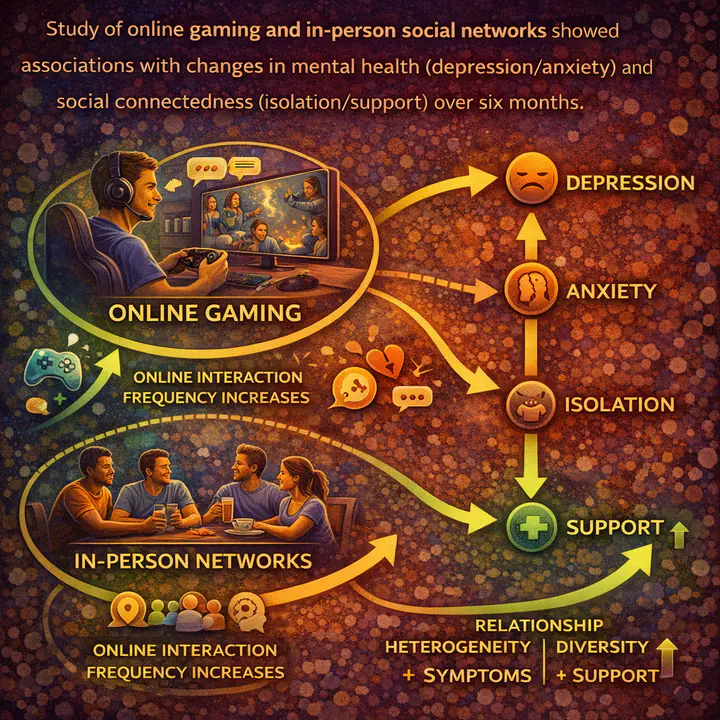
Purpose – Online gaming has emerged as a significant avenue for social connection, yet questions remain about how changes in gaming-related social networks influence mental health and social connectedness over time. This study aims to examine how changes in online gaming and in-person network characteristics were associated with changes in mental health outcomes (depression, anxiety) and social connectedness (isolation, social support) over a six-month period. Design/methodology/approach – Participants (n = 236) completed surveys assessing their online gaming and in-person social networks, mental health symptoms and social connectedness at two time points. Findings – Partial least squares regression models explained modest variance in outcome changes (R²: depression = 0.146; anxiety = 0.076; isolation = 0.134; support = 0.146). Increases in the diversity of how participants met their in-person network was associated with decreases in depressive symptoms (β = −3.74), while increases in online interaction frequency was associated with increases in symptoms (β = 1.34). For anxiety, increased in-person relationship heterogeneity was associated with higher symptoms (β = 2.88), while online relationship heterogeneity was associated with lower symptoms (β = −3.51). Changes in relationship quality metrics were consistently associated with outcomes as opposed to changes in network size or interaction frequency. Notably, improvements in both online (β = 1.83) and in-person (β = 2.53) relationship quality were associated with increased social support. Originality/value – These findings suggest that while online gaming relationships may complement in-person connections, they may not effectively substitute for diverse in-person interaction. Results emphasize the importance of maintaining varied in-person social connections while leveraging online gaming relationships as supplementary rather than primary sources of social support.